The Senckenberg Natural History Museum Frankfurt opens the new theme room “Coral Reef” as part of the remodeling project New Museum
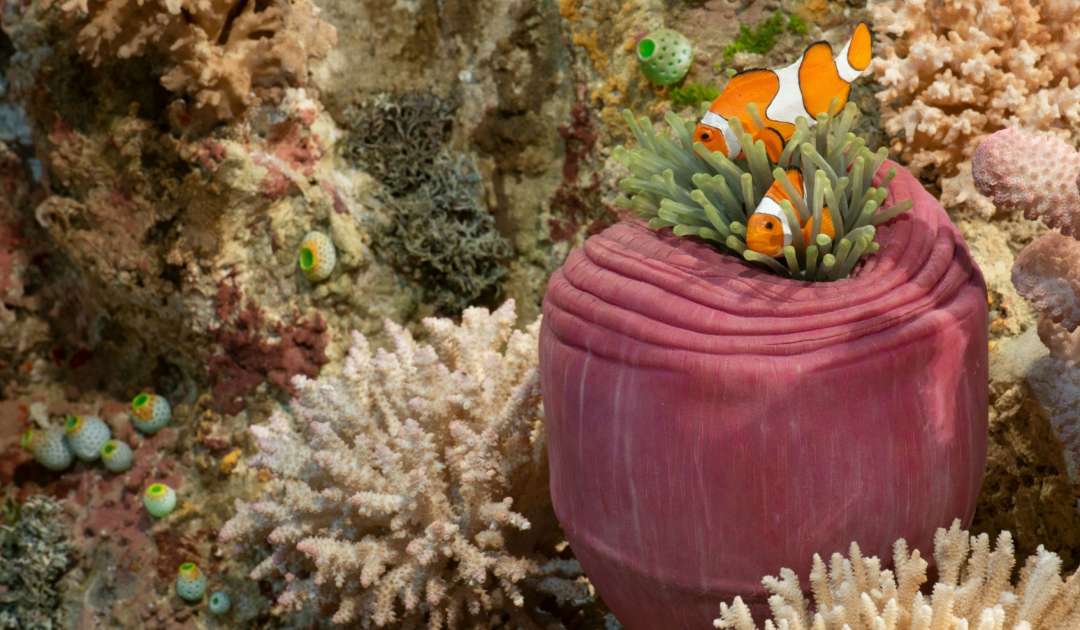
Coral reefs are, besides the tropical rainforests, the ecosystems with the greatest biodiversity and productivity worldwide. While they cover only about 0.2 percent of the ocean floor, they harbor a third of the marine fauna. The diversity of its fascinating, brilliantly colored organisms can be experienced in the new coral reef exhibition. In a 6 meters long and 2.50 meters high coral reef installation, visitors can discover more than 1,000 objects: from porcupinefish to dancing feather stars to a hunting school of whitetip reef sharks.
Over the course of three years, a team of three taxidermists were developing the diorama of an indo-pacific coral reef in close cooperation with Senckenberg scientists. With their work, they pursue two aims: a lifelike rendering of the diverse organisms, and the conveying of stories and interactions. The models show the reef dwellers in action – for example, a sea turtle in a cleaning station, or an octopus foraging for food. The reef can be experienced by day and by night. One section is also devoted to the existential threat posed to this precious ecosystem by climate change and other human influences.
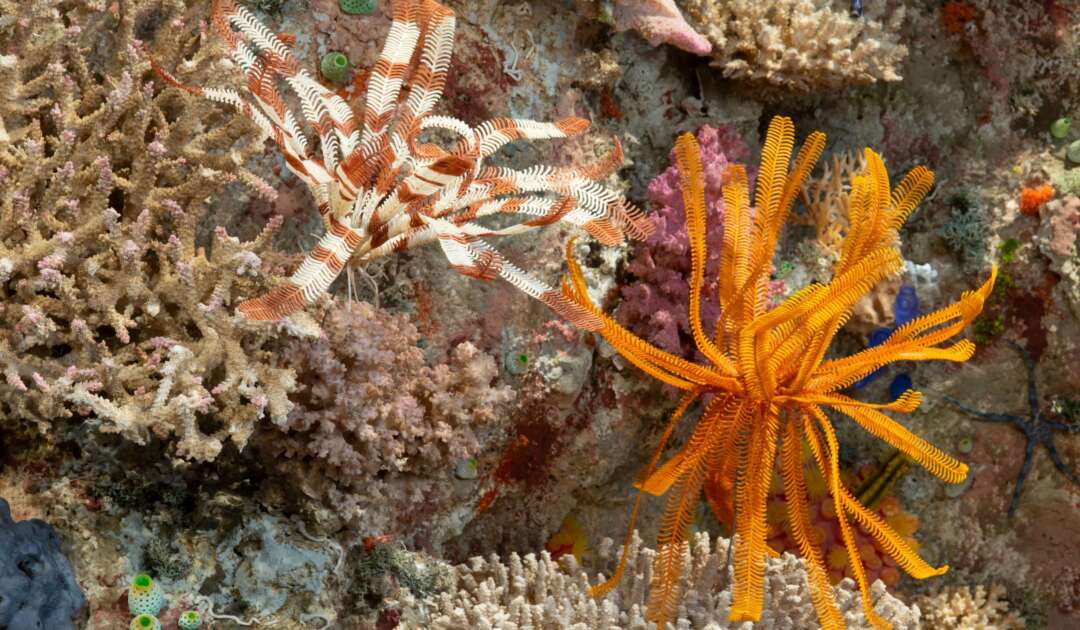
On the left a long-armed feather star (Dichrometra flagellata)
The Making Of shows how the exhibition was created over a period of three years. In addition, the taxidermists Hildegard Enting, Anna Frenkel and Kay Weber tell how they proceeded and what challenges they had to face.
We thank our supporters who made the exhibition “Coral Reef” possible:
Erika and Walter Datz-Stiftung
Okeanos Stiftung für das Meer
Mitglieder der Senckenberg Gesellschaft
Jürgen R. and Eva-Maria Mann Stiftung
and other private individuals and foundations
The Leibniz Centre for Tropical Marine Research (ZMT) in Bremen dedicates its research and teaching to a better understanding of tropical coastal ecosystems such as mangroves, seagrass beds, coral reefs, estuaries and upwelling areas. The focus is on questions about their structure and function, their resources, and their resilience to human intervention and natural change. With its work, the institute creates a scientific basis for the protection and sustainable use of these habitats. The ZMT conducts its research projects in close cooperation with partners in the tropics, where it supports the development of expertise and infrastructure in the field of sustainable coastal zone management. The ZMT is a member of the Leibniz Association.
Trier University of Applied Sciences stands for high-performance and application-oriented research that opens up a broad spectrum of study opportunities. In the further development of teaching methods, Trier University of Applied Sciences focuses on innovation and practical relevance. Furthermore, project- and team-oriented learning promote the social competence of the students. Research and development at Trier University of Applied Sciences address current problems in society. The Intermedia Design program at the Department of Design offers a comprehensive study of digital media with a high level of practical relevance. www.intermedia-design.de
Donnerstag, 16.05.2024
Die Aha?! Forschungswerkstatt bleibt an diesem Tag geschlossen.
Bitte beachten Sie auch die temporären Sperrungen im Museum bei der Planung Ihres Besuchs.
Eintrittspreise
Regular Tickets
Adults (from 18 years)
12,00 €
Discounted Tickets
Children and teenagers (aged 6 - 17), conscripts, civilian servants, school aged and students with student ID
6,00 €
Frankfurt-Card 50% Owner
6,00 €
Frankfurt-Pass adults
6,00 €
Frankfurt-Pass children
3,00 €
Kulturpass adults
1,00 €
Kulturpass children
0,50 €
Group Tickets
Groups numbering 20 or more (price per person) from 18 years
10,00 €
Kindergartens, School classes, Associations
One accompanying person free per booked tour
Each additional accompanying person per booked guided tour
3,00 €
Children, school aged, teenagers from 6 years
4,50 €
Escorts of Kindergartens (every 2nd child)
5,00 €
Member School
0,00 €
Students (Guided Tour)
3,00 €
Family Tickets
Family: 2 Adults and up to 3 children between 6 and 17 years
30,00 €
Mini Family: 1 Adult and 2 children between 6 to 17 years old
18,00 €
Family App Hessen (formerly Family Card Hessen)
2 adults and all children under the age of 18
27,00 €
Good Evening-Ticket
On Wednesdays effective from 5pm, visitors from 18 years
6,00 €
Annual season ticket (Naturpass)
Annual Season Ticket 6 - 14 years old and disabled from 50 GdB
40,00 €
Annual Season Ticket from 15 years
90,00 €
Free admission
Accompanied refugee groups
Children under the age of 6
Disabled children from 50%
Escorts of disabled (from 50% on), in case support is essential for the visit of the museum
Groups with SGN company member card
ICOM members with ICOM card
Members of the Circle of Friends (including family) with Circle of Friends member card
One accompanying person per guided tour (only kindergarten, school classes and associations)
Press members with press card
Senckenberg-School Runkel/Villmar
SGN members (including family) with SGN member card
Tourist guides with official guide card of the Frankfurt Tourist Office
Trainees of Frankfurt City Council with confirmation
Visitors from twin towns of Frankfurt city with identity card
Volunteers with confirmation
Your donation for the Senckenberg Society
With your donation, you help the Senckenberg Society to conduct natural scientific research and make our results accessible to the public through publications, exhibitions, educational projects, and many other initiatives.